The Society was contacted by a lady in Canada who was interested in finding out where Loves Garden used to be in the village. A chance find of a former resident’s Will found a connection between it and Butts Farm.
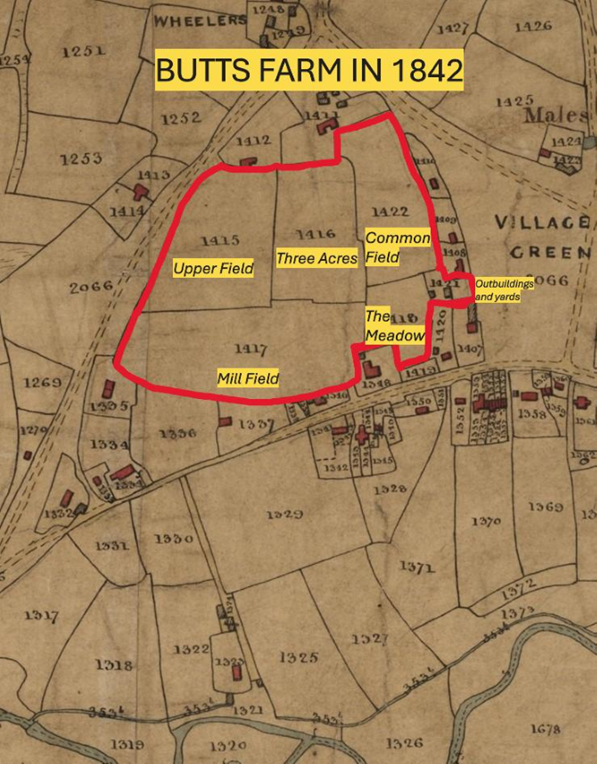 Butts Meadow perhaps has its origin in the archery butts that would have existed to enable mediaeval villagers to discharge their legal duty in gaining proficiency as archers. However, for a few hundred years up until the 1950s, what is now Butts Meadow and the surrounding buildings was the site of Butts Farm (sometimes referred to in contemporary documents as just “Butts.”)
The chance find was the will of Rhoda Tobitt, who died in 1846. She owned both Butts Farm and Loves Garden and both were mortgaged. In her will she directed that her nephew and executor, George Clayton, illegitimate son of her late sister Elizabeth Clayton, should sell the properties to pay down the mortgages.
Rhoda Clayton was born in 1767 but she was baptised late in life, in 1807, when she was 40 years old. In 1813 she married Thomas Tobitt, a widower, who the Wisborough Green parish register notes was “of Hawkhurst in the County of Kent.” In fact, Thomas was probably born near Dorking in 1759 but moved with his parents to Kent when he was young. Notwithstanding, the Tobitt family had a presence in and around Wisborough Green – one Samuel Tobitt was a Parish Overseer between the years 1815 and 1822. They were also related by marriage to the Pacy, Elliott and Napper families, all landowners or farmers prominent in parish affairs.
Thomas Tobitt died in 1828 in Kent so it is probable that he and Rhoda had returned to his family farm after their marriage. The farm was sold in 1829 and Rhoda came back to Wisborough Green where the 1841 Census found her living with her sister Elizabeth and her nephew George who was a Surveyor of Highways. Rhoda died on 13th October 1846.
At the time of writing her will, Butts Farm was occupied by a William Saunders, but Loves Garden was unoccupied although the will states it had previously been held by James Songhurst. The extent of the property was a “freehold and copyhold messuage, cottage, garden and premises.”
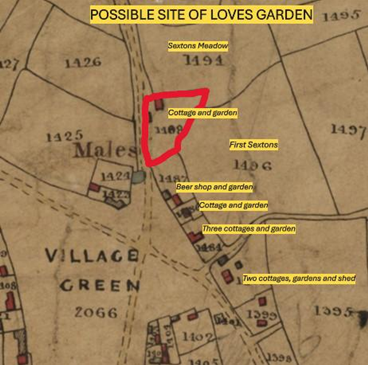 The 1842 Tithe Map doesn’t name Loves Garden, but a cottage and garden in the occupation of James Songhurst and seemingly owned by Rhoda Tobbitt is shown, to the north of what is now the Cricketers and roughly where the properties “Warwick” and “The Nook” are today.
This seems to be confirmed by the 1901 Census, where the enumerator has made his way north from the Cricketers to an un-named dwelling, then to The Nook and then to Loves Garden. Here he stops, turns back, and takes up his pencil again at the School House.
The 1881 Census records a Loves Cottage with no inhabitants (and, incidentally, introduces us to “Belchamber Row” which appears to be the then name for the line of dwellings either side of and including the Cricketers). In 1900, J Balchin operated a business from Loves Garden and took out a series of newspaper advertisements to publicise his services.
Returning to Butts Farm, the first housing estate built on the land very nearly wasn’t called Butts Meadow. Petworth Rural District Council rejected the name when it was submitted by the parish council preferring instead “Butts Fields.” Why the rural district council later changed its mind remains to be discovered.
This is an edited version of an article that first appeared in the January 2025 edition of the history society’s monthly magazine.
Andrew Strudwick